95% In-House Parts: Inside Juyon Radiator Factory

95% of Every Juyon Radiator Is Made Under One Roof — Here Is What That Actually Takes
Plenty of radiator "factories" are really assembly shops. The core arrives by truck from one supplier, the plastic tanks from another, and the fittings and brackets from a third. We went the other way: around 95% of what goes into a finished Juyon radiator is produced in our own plant. This article is about what that took to build — and what it means for you.
Ask a supplier where their radiators are made and you will usually get a truthful answer that hides the important part. Yes, final assembly happens in their building. What they may not mention is that the brazed core was bought in, along with the tanks, the oil cooler, the pressure caps and most of the brackets. What looks like a factory from the outside is often a well-organised assembly shop.
For years that model worked well enough, and plenty of businesses still run on it. The problems appear on the days when it doesn't. The core supplier's furnace goes down, and suddenly there is nothing to assemble and nothing to ship. A batch of cores comes out with weak joints, and nobody notices until assembly — after the cores are paid for, the freight is booked, and the delivery date has been promised to a customer. Every one of those hand-offs between suppliers is a place where a delay or a defect can slip through unnoticed.
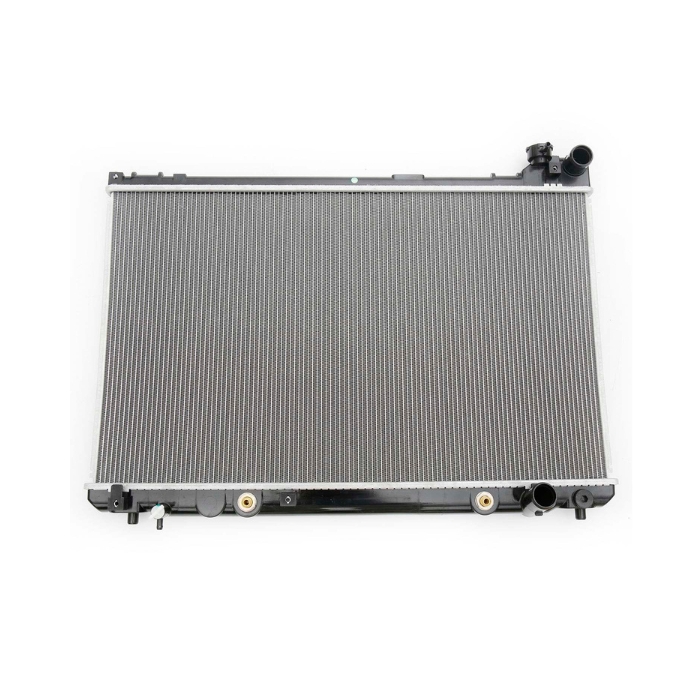
We decided a long time ago that we did not want our product to depend on that chain. Today, around 95% of the components in a finished Juyon radiator are made in our own plant — the brazed aluminum core, the tanks, the brackets, the fittings, nearly all of it. Getting to that point took years of investment, and it changed how we run the business. Below is an honest account of what it required, and what it delivers for the distributors and workshops who buy from us.
First, a word on why 95% is rare
Vertical integration at this level is a capital and engineering decision, not a marketing claim. It is far easier to say than to do.
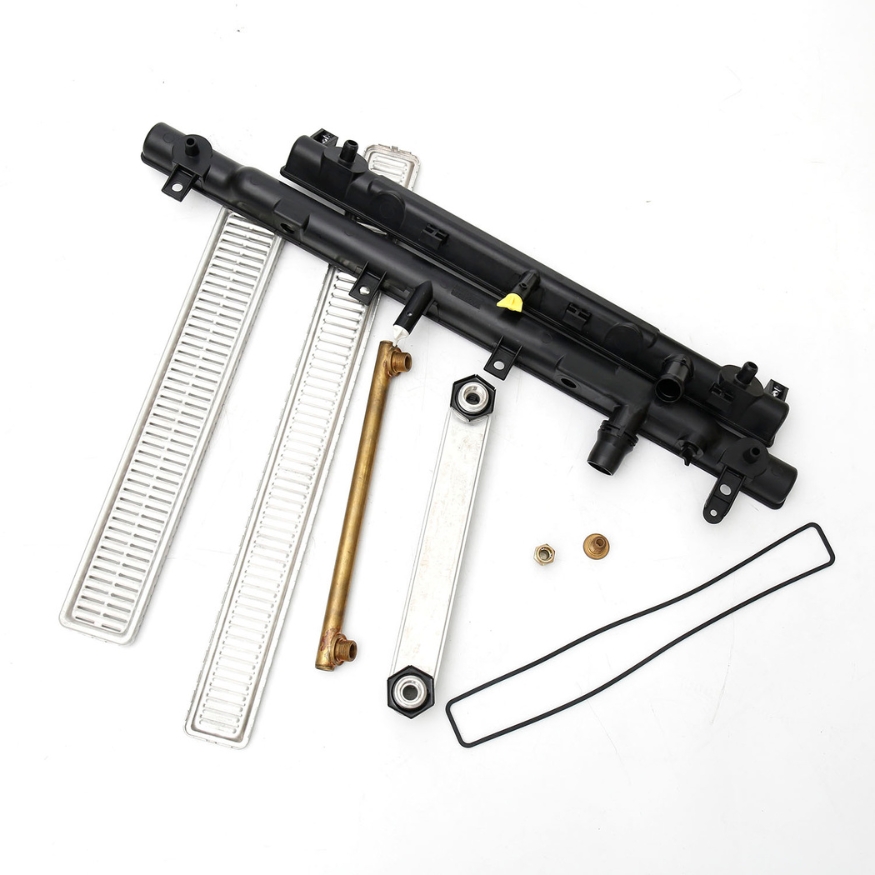
A single radiator holds dozens of parts: the brazed core with its tubes, fins, headers and side plates; the inlet and outlet necks; upper and lower tanks; an internal transmission oil cooler on many applications; a filler neck and pressure cap; mounting pins, rubber cushions, a drain plug, brackets — and on some models a fan shroud or a sensor port as well.
Each of those parts belongs to a different manufacturing discipline. The core needs aluminum tube forming, fin rolling and controlled-atmosphere brazing. The tanks need injection moulding. The brackets need stamping. The oil cooler needs tube bending and assembly. Most suppliers become good at one or two of these and buy the rest in. Covering all of them means running something closer to a small industrial park than a single workshop, and accepting the management burden that comes with it.
01What it takes: five capabilities behind the 95%
1. Owning the whole production chain, step by step
Making 95% of a radiator in-house means each of these stages runs as our own line, with our own equipment, maintenance plan and trained operators: aluminum strip inspection and slitting, tube forming, fin rolling and louvering, core stacking, controlled-atmosphere brazing, tank injection moulding, bracket stamping, tube bending, crimping and welding, leak testing, painting and packing. A process like brazing cannot be half-owned. Either the furnace is ours and we set the temperature profile and conveyor speed, or we are waiting on someone else's schedule and hoping their yield was good that week.
2. Our own tooling and dies
This may be the most underrated capability on the list. Plastic tanks need injection moulds. Brackets need stamping dies. Cores need stacking fixtures and brazing jigs. A supplier who outsources tooling has to queue behind other customers every time a new model is developed, and every design revision restarts that wait. With moulds and dies in-house, a new application, an engineering sample or a small-batch variant moves on our schedule instead. It is the difference between quoting a launch date and guessing one.
3. Engineers who own the joints between processes
When the core, tanks and brackets come from three different companies, nobody is responsible for how they fit together. If the header slots and the tank seam do not line up, the two suppliers will each insist their own drawing is correct, and the assembler spends its days refereeing. Our engineering team specifies tolerances across the whole assembly — header slot positions, tank seam geometry, bracket hole centres — so the finished radiator bolts straight in. The same team works in the other direction too: a customer sends a sample or an OEM number, and we turn it into drawings, tooling and a production route.
4. Capacity planning that can absorb a peak season
Owning 95% of the process also means owning 95% of the bottleneck risk, so the plant has to be planned as a whole. If the brazing furnace is the slowest step, the moulding shop finishing early does not help anyone. In practice this means running more than one line, keeping a shift structure that can flex, and using production planning to separate two kinds of work: building stock during the quiet months, and fulfilling orders when demand peaks.
5. Working capital, committed on purpose
This one is invisible to buyers but it supports everything else. Keeping finished radiators on a shelf for months ties up real money — in aluminum coil, in sub-assemblies, in boxed goods waiting for an order. A trading company cannot carry that weight without crushing its cash flow. A vertically in

02 Abundant stock
Juyon holds substantial inventory — covering both core components and finished goods — enabling small-batch, fast-turnaround supply.
03 Quick lead time — because the dependency chain is short
Lead time isn't a number a salesperson picks. It's the length of the longest wait in the chain.
For an assembler, that wait is usually the core supplier: place the order, queue for their production slot, hope their brazing yield holds, wait for the truck, then assemble. A "20-day lead time" quietly becomes 45 when one link slips — and you often find out at the very end, when the container is already booked.
At Juyon, the components are produced in-house and the key equipment is our own, so most of those links simply disappear:
- Stock orders ship from the shelf. For applications already in the warehouse, the constraint is loading and paperwork, not manufacturing.
- Production orders start on our schedule. There's no external supplier's brazing queue to wait behind — the furnace is ours, and we can see the queue ourselves.
- Small problems stay small. A damaged tank or a missing bracket is fixed in the same plant, often the same day, instead of triggering a four-week replacement shipment.
- Mixed containers are practical. With the whole range produced internally, a container can carry many part numbers instead of whatever one supplier happens to be running that month.
04 End-to-end quality control — one owner for every defect
Quality problems cost the most at the boundary between companies. Inside one plant, they get fixed where they started.
The classic failure in a multi-supplier chain is the blame loop. A core leaks. The core maker says the tank crimp was wrong. The assembler says the core was out of tolerance. Weeks go by, nobody changes anything, and the distributor absorbs the return while the workshop absorbs the comeback.
Inside one plant that loop cannot form, and several things follow from it:
- One process owner. Brazing parameters, moulding conditions, stamping tolerances and assembly torque all sit under the same quality system, filed against the same batch code.
- Checks at every hand-over. Coil coming in, cores leaving the furnace, tanks leaving the mould, units leaving assembly — each transition has its own acceptance criteria, because each one is ours to check.
- Fast, closed-loop correction. If a leak trend appears, it can be traced to a specific furnace zone or mould cavity within the same shift, and the fix is made there — not in a supplier's shipment three weeks later.
- Reorders that do not drift. The alloy, the fin pitch, the wall thickness and the tank resin stay the same from one order to the next, because they come from the same controlled process.
- Documentation you can audit. A buyer or third-party inspector can walk the entire route — material, process, test, packing — inside a single facility.
FAQ Frequently asked questions
What is the remaining 5% that is not made in-house?
It is limited to specialist inputs rather than structural parts — for example certain sealing materials, hardware and surface treatments where a dedicated specialist simply does the job better. Every structural and functional component of the radiator itself is produced in our plant.
Does in-house production mean higher prices?
In our experience it usually does the opposite. Cutting out the margin layers between suppliers, controlling scrap at the source and running our own tooling all bring landed cost down. What in-house production really demands is capital, which is why smaller suppliers rarely attempt it.
Can I mix several part numbers in one container?
Yes. Because the range is produced internally and held as finished goods, mixed containers and trial orders are routine for us rather than a special favour.
How fast can a new application be developed?
It depends mainly on whether the tooling already exists. Applications we can run on existing moulds and dies move quickly. A genuinely new application runs on our own mould and die schedule, which removes the external queue that usually dominates this kind of timeline.
How do you keep quality consistent between reorders?
By keeping the inputs constant: verified aluminum coil, recorded brazing recipes, controlled moulding parameters and the same test criteria applied to every unit. Each shipment carries a batch code that ties it back to those records.