Car Radiator Price Guide: What B2B Buyers Need to Know
Price is the easiest thing to compare and the hardest thing to get right. Two radiators quoted at $22 and $34 may both be "passenger car aluminum radiators" — but only one of them will still be cooling a customer's car three summers from now.
Every B2B buyer wants a competitive price. The problem is that radiator pricing is not a single number — it is the output of materials, core design, manufacturing process, certification, order volume, and freight. This guide breaks down what actually drives a car radiator's price, what the real market ranges are, how volume discounts work, and how to calculate the landed cost that determines whether your order makes money.
What actually drives the price of a car radiator
Five factors account for almost the entire spread between a $15 radiator and a $250 one.
1. Materials: aluminum or copper-brass
Raw materials are the single largest cost component. In a typical aluminum radiator, metal accounts for roughly 40–50% of the factory cost, with plastics and composites adding another 15–20%.
- Aluminum brazed — the standard for vehicles built after 2000. Lighter, better heat transfer per kilogram, lower material cost. Requires a controlled-atmosphere brazing (CAB) furnace, which is why not every workshop can make one.
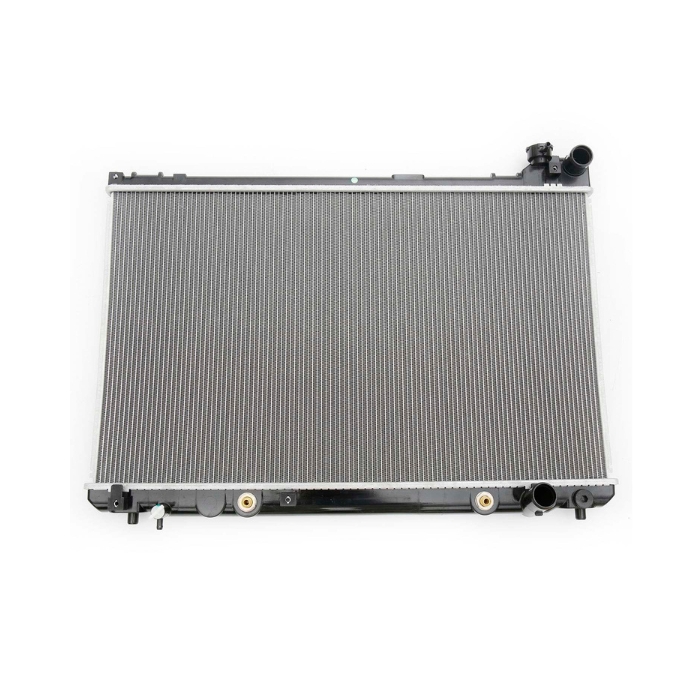
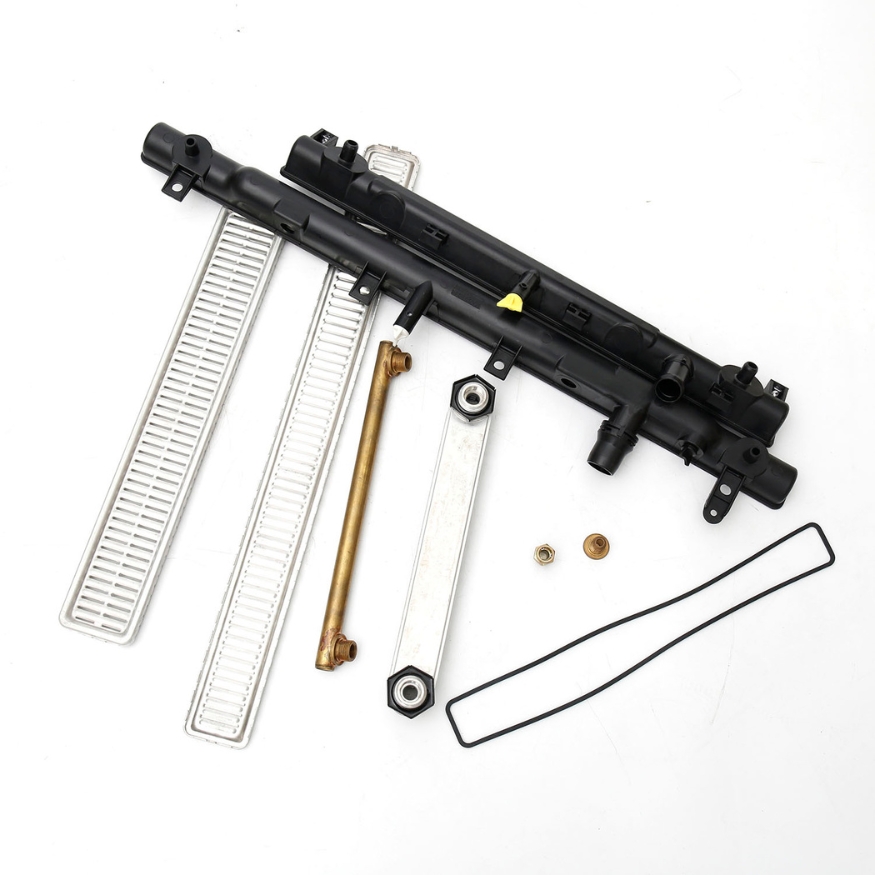
- Plastic-aluminum — aluminum core with PA66-GF30 plastic tanks. The most common configuration for modern passenger cars and usually the most cost-effective.
- All-aluminum — brazed aluminum tanks instead of plastic. Higher cost, higher durability, used in performance and heavy-duty applications.
- Copper-brass soldered — heavier, more corrosion-resistant in some environments, and still preferred for legacy vehicles, tropical markets, and equipment repaired in the field. Higher material cost, simpler manufacturing.
Aluminum is a commodity, and so is its price. LME aluminum has traded roughly between US$2,100 and US$2,800 per metric ton in recent years — when the metal moves 20%, your quotes move with it. Suppliers who lock prices for six months without asking about metal trends are either absorbing risk or planning to substitute material.
2. Core size, rows, and fin density
A bigger core means more material — there is no way around it.
- Core dimensions (height × width × thickness) determine how much tube, fin, and header material goes into the unit.
- Rows (single-row vs multi-row cores) increase capacity and cost in steps.
- Fin density (FPI) sits at the centre of the quality-versus-cost trade-off: denser fins improve heat rejection but use more material and demand tighter tooling. Thinner fins and lower FPI are one of the most common ways a cheap radiator is made cheap.
3. Construction and brazing process
How the core, tubes, and tanks are joined decides both the price and the failure mode.
- Controlled atmosphere brazing (CAB / Nocolok) and vacuum brazing produce strong, leak-free joints and require real capital equipment.
- Mechanical assembly and thin soldered seams cost less to produce and are far more likely to fail under pressure and vibration.
The visible difference: uniform, void-free brazing fillets along the tube-to-header joints. The invisible difference: how many units fail a leak test in month nine.
4. Certification and quality system
An IATF 16949 quality system is not paperwork — it is the cost of the audits, the process controls, and the testing stations behind it. Factories that hold it and test 100% of units carry a higher cost base than those that sample-test. That difference shows up in the price, and it shows up again in your return rate.
5. Order quantity, packaging, and branding
Finally, the commercial layer: order volume, packaging specification (single cartons vs multi-packs), your own branded boxes, and whether the factory is running your model in an existing production batch or opening a dedicated run.
Typical FOB price ranges from China
The table below reflects approximate FOB pricing from Chinese radiator factories at aftermarket quality, for reference when you compare quotes.
| Radiator type | Typical FOB price (per unit) | Notes |
|---|---|---|
| Passenger car, aluminum | US$15–45 | Wide spread reflects core size and quality tier |
| Passenger car, copper-brass | US$25–60 | Higher material cost; legacy and tropical markets |
| Light truck | US$30–80 | Larger cores, heavier tanks |
| Heavy truck | US$80–250 | Multi-row cores, reinforced construction |
| Construction equipment | US$150–500 | Engine-specific, low volume, high material content |
Two buyers can hold quotes at opposite ends of the same row and both be quoted honestly — because they are not buying the same radiator. When a quote lands well below the bottom of the range for a modern passenger car application, ask what was removed.
Price tiers: what each level actually buys you
Radiators are not split into "good" and "bad" — they are graded, and each grade serves a different channel. Knowing which tier you are buying is more useful than knowing the unit price.
| Tier | Typical relative price | Core & brazing | Expected service life | Best suited to |
|---|---|---|---|---|
| Budget / economy | Baseline | Thin fins, lower FPI, lighter tanks | Short — highest failure risk | Price-driven retail, short-hold vehicles |
| Mid-tier aftermarket | +15–35% over budget | Standard fin density, CAB brazing, 100% leak test | Solid service life | General wholesale, workshops |
| Premium / OE-equivalent | +50–100% over budget | OE-benchmarked core, tight tolerances, corrosion coating, full testing | Long service life | Fleets, warranty-sensitive channels |
A useful rule of thumb for your own margin analysis: the cheapest tier usually costs the most per year of service, because a shorter lifespan means more replacements, more freight, and more labour — all of which you or your customer pay for.
OEM vs aftermarket: how big is the real gap?
OEM radiators are made to the vehicle manufacturer's specification and sold through dealer networks with dealer overhead. Aftermarket equivalents serve the same function at a fraction of the price. In most passenger car applications, OEM pricing runs 20–60% higher than comparable aftermarket options, and the gap widens on vehicles where the dealer is the only practical channel.
| Vehicle segment | Typical OEM (dealer) | Typical aftermarket | OEM premium |
|---|---|---|---|
| Compact car | US$220–280 | US$95–140 | 57–66% |
| Mid-size sedan | US$280–380 | US$130–180 | 54–73% |
| Full-size truck | US$350–500 | US$150–225 | 57–122% |
| Luxury vehicle | US$450–700 | US$200–350 | 56–100% |
For a distributor, the practical question is not "is OEM better?" but "does the premium buy measurable value in my channel?" For fleet maintenance contracts, exact fitment and durability matter most. For a wholesale distributor serving mixed workshops, SKU coverage and stock rotation usually matter more — and a premium aftermarket line covers that ground at a better cost-to-risk ratio than OEM parts.
How volume pricing actually works
Volume discounts on radiators are real, but they are smaller and more structured than most first-time buyers expect. The typical pattern:
- Samples and trial orders (1–20 units) — effectively list price, often plus sampling or setup fees.
- Standard aftermarket MOQ (typically 50–200 units per model) — the base production price. Buyers sourcing 2–3 containers across a range of models usually land here.
- Mixed-container consolidation — you do not need 500 units of one model to get a container rate. Factories that allow mixed models to a combined minimum give you breadth without dead stock.
- OEM and private-label programmes — usually start at 500–1,000 units per model, because they involve tooling confirmation, branding, and dedicated production. This is where per-unit pricing improves most.
What to negotiate beyond the unit price: payment terms, packaging specification, sample reimbursement on the first order, and the price validity period given metal volatility. A supplier who will not put a price validity window in writing is not protecting your budget.
Landed cost: the number that really matters
Your unit price is not your cost. The full landed cost of a radiator order typically includes:
| Cost element | Typical figure |
|---|---|
| FOB unit price | Per quote |
| International freight | ~US$1,500–2,500 per 40-ft container from Asia to major import hubs |
| Insurance | ~0.3–0.5% of CIF value |
| Import duty | Varies by market — e.g. ~5% in GCC countries on cooling components |
| Customs clearance & local delivery | Market-dependent |
| Fitment rework | 0.5–2.0 extra labour hours per vehicle when brackets or ports don't align |
| Warranty & returns | Reverse logistics, credits, and admin per failed unit |
This is where the arithmetic gets uncomfortable for buyers chasing the lowest quote. A radiator priced 15% cheaper on paper can end up 8–20% more expensive once claims, returns, and inconsistent fitment are counted. Fitment problems are always more expensive than they look, because a radiator that does not install cleanly costs labour that has nothing to do with the part price.
There is also a regional dimension: landed prices from Chinese and Indian suppliers typically run 30–50% below equivalent OE-quality parts from European or Japanese suppliers — which is exactly why sourcing from China is worth doing carefully rather than cheaply.
Six signs of a price that's too good to be true
- The quote is far below the range for the application — extra cost has to come from somewhere: thinner fins, fewer rows, lighter tanks, or no full testing.
- No 100% leak testing — for a pressure vessel, sample testing means known defects ship to your customers.
- Certificates that cannot be verified — check IATF 16949 and ISO 9001 certificates with the issuing body.
- No OE cross-reference — if the supplier only has a price list and no fitment data, you are buying a bracket lottery.
- Price held "indefinitely" regardless of metal prices — either the specification is flexible or the price is not real.
- Vague warranty terms — a written policy covering replacement parts and freight is the minimum.
A serious factory will happily explain where its price comes from: material grade, fin density, brazing method, testing regime, and lead time. If a supplier cannot explain the price, they cannot guarantee it.
FAQs about car radiator pricing
How much does a car radiator cost wholesale?From Chinese factories at aftermarket quality, typical FOB prices are roughly US$15–45 for passenger car aluminum radiators, US$30–80 for light truck units, US$80–250 for heavy truck radiators, and US$150–500 for construction equipment applications. Copper-brass passenger car radiators usually run US$25–60.
Because it is not the same radiator. Cheaper quotes typically mean lower fin density, thinner tanks, lighter material gauges, mechanical assembly instead of brazed joints, or sample-only leak testing. Ask for the specification behind the number before comparing prices.
Aftermarket radiators generally run 20–60% below comparable OEM pricing, and the gap can exceed 100% in some vehicle segments. For most wholesale and workshop channels, premium aftermarket lines offer the best cost-per-year-of-service ratio.
Aftermarket orders typically start at 50–200 units per model, and many factories consolidate mixed models into a combined minimum so you are not forced into dead stock. OEM and private-label programmes usually start at 500–1,000 units per model.
Add freight (about US$1,500–2,500 per 40-ft container from Asia to major import hubs), insurance, import duty, customs clearance, and local delivery to the FOB price — then factor in fitment rework and warranty exposure. A radiator 15% cheaper on paper can end up 8–20% more expensive after claims and returns.
Get an honest radiator price from a manufacturer
At JUYON Radiators, we manufacture car radiators, condensers, evaporators, and thermal management components with ISO 9001 certified quality systems and 100% leak testing on every unit. Our quotes come with the specification attached — material grade, core configuration, brazing method, and testing regime — so you can compare like for like instead of comparing numbers.
We support mixed-container aftermarket orders, OEM programmes, private-label packaging, and OE part number cross-reference. Tell us your market and volume, and we will give you a price you can plan on.